The sand under your feet has a color you don't expect: it is not the dazzling white of tropical postcards, nor the golden beige of the Mediterranean. It is pink, a soft and real pink, mixed with the morning light as if someone had poured ground coral directly onto the shore. And that is exactly what happened. Pink Beach, locally known as Pantai Merah, is located on the island of Komodo, in the Lesser Sunda Islands archipelago, in the Indonesian province of East Nusa Tenggara, and is one of the very few beaches in the world with naturally pigmented pink sand.
The chromatic phenomenon is the result of millions of fragments of red coral — mainly belonging to the Foraminifera species, reddish-shelled marine microorganisms — that the currents deposit on the shore, mixing them with white limestone sand. The visual result changes depending on the time of day and light conditions: at sunset, the beach shifts towards purple, in the midday hours the pink lightens to almost peach. Observing it live, with your feet in the turquoise water, is an experience that is hard to forget.
The color of the water and the coral reef

The water in front of Pink Beach is a spectacle in itself. The color gradient ranges from emerald green near the shore to a deep cobalt blue just a few meters away, indicating the rapid depth of the seabed. Underwater visibility is exceptional for much of the year, and just a few meters from the shore, you encounter live and colorful coral formations, inhabited by parrotfish, moray eels, and schools of brightly colored tropical fish.
The Komodo National Park, established in 1980 and recognized as a UNESCO World Heritage Site in 1991, protects the entire marine and terrestrial ecosystem of the archipelago. The waters of the park host over 1,000 species of fish, more than 260 species of coral, and at least 70 species of marine sponges. Snorkeling at Pink Beach means immersing yourself directly in this ecosystem, without the need for advanced equipment: the reef is accessible even to less experienced swimmers.

The Komodo Dragons on the Hills
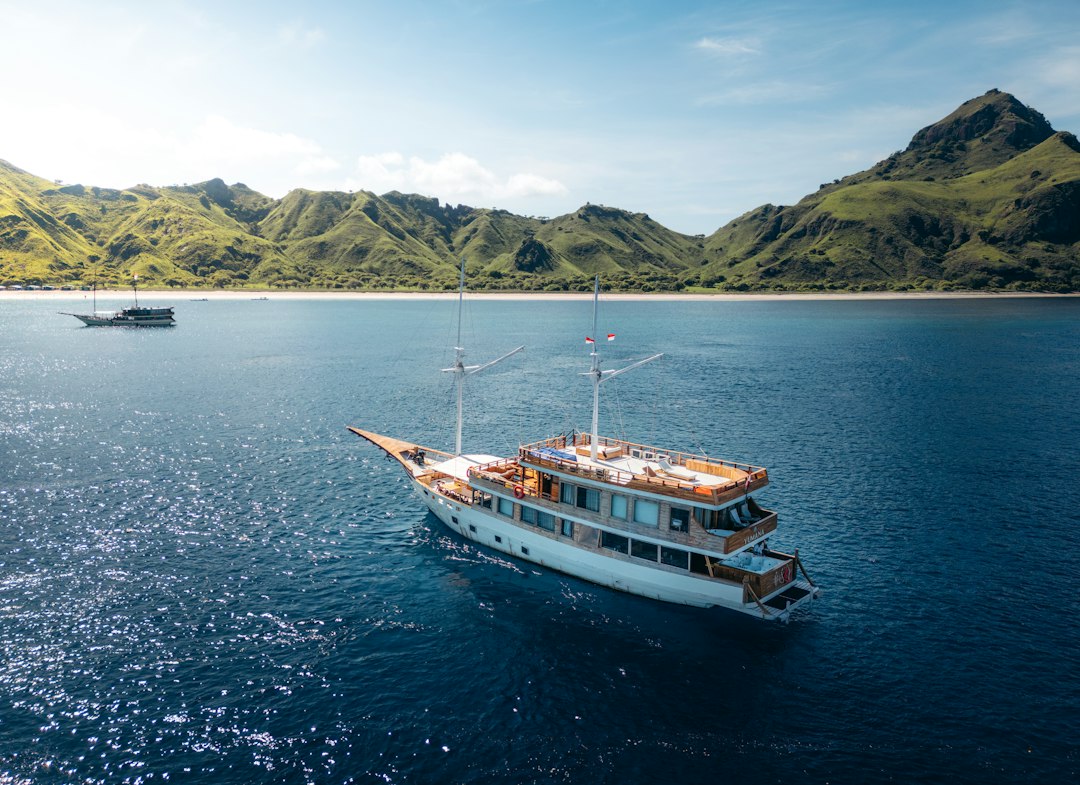
Pink Beach is not just sea. Behind the beach rise dry and barren hills, covered with dry yellow grass and sparse shrubs — a landscape that resembles certain corners of sub-Saharan Africa more than the typical tropical imagery. It is in this environment that the Varanus komodoensis, the Komodo dragon, lives, the largest living reptile in the world, which can reach lengths of up to 3 meters and weigh up to 70 kilograms.

It is not uncommon to spot individuals moving slowly along the paths or resting in the shade of trees near the beach. These are not domesticated animals: they are wild predators, and the park requires that visitors are always accompanied by authorized rangers. Spotting a dragon just a few meters from the shore, with the pink sand behind and the turquoise sea in front, creates a visual and sensory contrast that is difficult to describe with ordinary words.
How to get there and when to visit

The most common starting point to reach Pink Beach is Labuan Bajo, a town on the island of Flores connected by direct flights from Bali (Denpasar) and Jakarta. From Labuan Bajo, boat tours are organized — both daily and multi-day — that include Pink Beach among the stops on the itinerary in the park. The fast boat crossing takes about 2-3 hours depending on the type of vessel and the chosen route.
The best time to visit is between April and October, during the dry season, when the sea is calmer and underwater visibility reaches its peaks. From November to March, rains and winds can make navigation more difficult and the water murkier. An important practical tip: arriving at the beach in the early morning, preferably before 9:00 AM, allows you to enjoy the most beautiful light for photographing the contrast between the pink sand and the sea, and to go snorkeling before the boats from organized tours crowd the area. The entrance ticket to Komodo National Park for foreign visitors is subject to seasonal and policy variations — at the time of planning, it is advisable to check the updated rates with the park authorities or the reference agency, as various rate updates have been discussed and implemented in recent years.
The atmosphere and what to expect
Pink Beach is not a equipped beach in the European sense of the term: there are no beach clubs, umbrellas for rent, or bars on the shore. There is sand, sea, silence, and, during peak hours, other boats anchored in the bay. Bringing water and snacks is essential, as well as biodegradable sunscreen, which is mandatory to respect the protected coral ecosystem.
The atmosphere is that of a place still relatively intact, where nature sets the pace. The pink of the sand, the turquoise of the water, the green-yellow of the hills in the background, and the real possibility of encountering one of the oldest reptiles on the planet create a combination of elements that is hard to find elsewhere in the same geographical location.