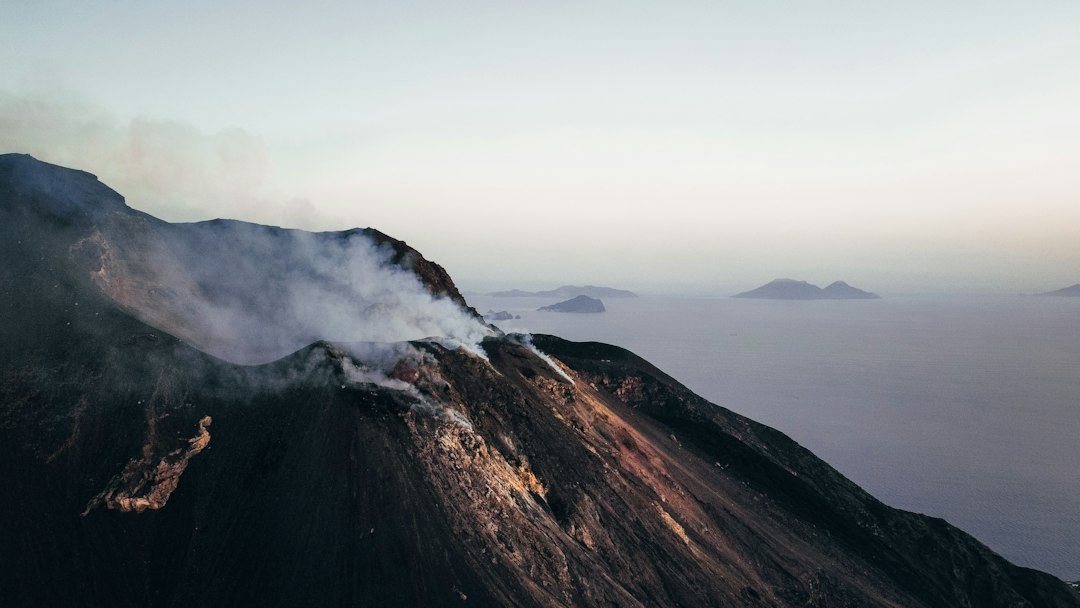

A muffled roar, then an orange glow that pierces the darkness. Stromboli erupts every twenty or thirty minutes, with an almost mechanical punctuality that volcanologists call Strombolian activity — a technical term that has entered the global scientific lexicon thanks to this island in the Aeolian archipelago. It is not a spectacle to be watched from afar on a screen: it is something that is felt in the bones, that is breathed in the warm air of sulfur, that is seen reflected on the black surface of the Tyrrhenian Sea.
The island is located in the archipelago of the Aeolian Islands, north of Sicily, and can be reached by ferry or hydrofoil from Milazzo or Naples. Its conical shape — almost perfect, almost unreal — rises to 924 meters above sea level, and the active crater is located just below the summit. Stromboli is one of the most active volcanoes on Earth, erupting almost continuously for at least two thousand years according to available historical documents.
The ascent to the crater: what to really expect
Italian regulations require that, to reach areas above 290 meters, visitors be accompanied by an authorized volcanic guide. It is not a bureaucratic formality: the ground is unstable, eruptions are unpredictable in their intensity, and visibility can drop in a matter of minutes. Local guides — many of whom grew up on the island and know every path — usually set off in the late afternoon to reach the crater's edge at sunset or shortly after, when the glowing lapilli become visible against the dark sky.
The hike takes about three hours of ascent on volcanic terrain: compact ash in the lower sections, crumbly lava rock at higher altitudes. Protective glasses and a mask against gases are mandatory, provided or recommended by local agencies. Upon reaching the authorized observation area, one witnesses the explosions from the Sciara del Fuoco, the lava flow channel on the northwestern slope of the island, which at night appears as a glowing wound on the black mountain.
The Strombolicchio and the village of Ginostra
Those who do not feel like climbing — or want to complete the experience — can observe the nighttime eruptions from the sea, aboard one of the boats that circumnavigate the island in the evening. The privileged observation point is right in front of the Sciara del Fuoco, where blocks of lava roll into the water and sometimes enter the sea with a cloud of white steam. It is a different spectacle, more distant but equally powerful.
A few hundred meters from the main island stands the Strombolicchio, a volcanic rock that houses an ancient lighthouse. The village of Ginostra, on the southwestern side of the island, can only be reached by sea and has only a few dozen permanent inhabitants: the streets are too narrow for any motor vehicle, and the atmosphere is that of a place that has remained outside of time.
When to go and practical advice
The best months to visit Stromboli are May, June, and September: the sea is navigable, temperatures are pleasant for walking, and the summer crowds of July and August are still absent or already thinned out. In the height of summer, the island fills up quickly and spots on guided excursions to the crater sell out days in advance — booking at least forty-eight hours in advance is essential.
The cost of a guided excursion to the crater is around 30-35 euros per person, but it can vary depending on the agency and the season. It is mandatory to wear sturdy-soled hiking shoes, layered clothing (at altitude, the wind can be cold even in summer), a headlamp, and enough water. Guides recommend never sitting downwind of the crater and to strictly follow instructions in case of changes in eruptive activity. Stromboli does not forgive carelessness, but rewards those who arrive prepared with one of the most extraordinary natural displays that Europe has to offer.
Where to sleep and eat on the island
The accommodation offer is concentrated in the village of San Vincenzo, on the eastern side, and in the nearby fractions. There are small hotels, bed and breakfasts, and vacation homes, many of which are run by local families. The island's restaurants offer Aeolian cuisine: fresh fish, capers from Salina, lemon granita. The island does not have large supermarkets, so it is useful to arrive with some supplies if staying for more days. Electricity and internet connection are available but sometimes intermittent — a detail that, in this context, seems almost appropriate.