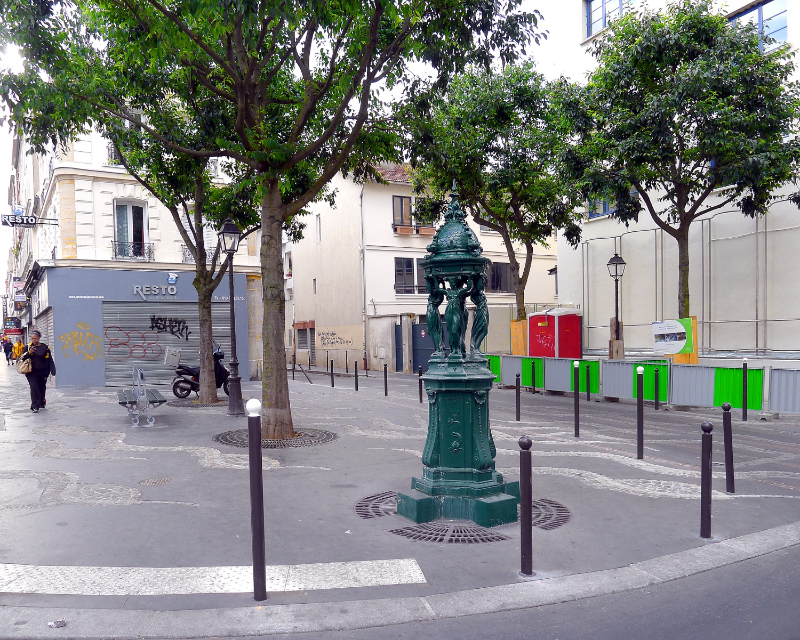

A symbol of Paris are the cast-iron Wallace water fountains which are scattered all over the city. You can fill up your re-usable water bottle from mid-March to mid-November (they’re stopped during the winter to prevent damage from ice).
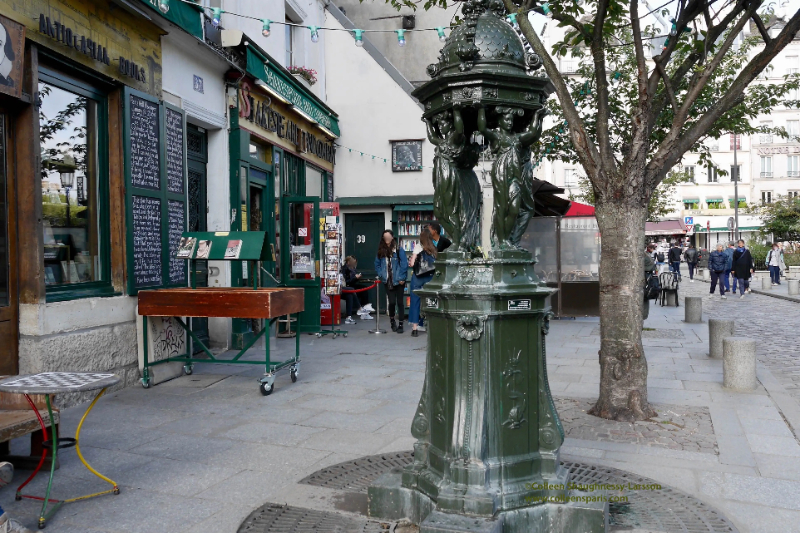
An Englishman, Wallace, funded the public fountains in 1872 to aid the poor of the city and Charles-Auguste Lebourg designed them. Each mademoiselle stands in a slightly different position and each possesses a different virtue; kindness, simplicity, charity and, aptly, sobriety. The non-profit Society of the Wallace Fountains is working hard to preserve the iconic Wallace fountains. The Paris water department (Eau de Paris) is responsible for their continued functioning.
Different models
The first two models (large model and applied model) were conceived and financed by Sir Richard Wallace. The two other models were created following the success of their predecessors inspired by the same styles and the resemblance is obvious. The more recent designs are not as strongly steeped in Wallace's aesthetic ideals, that in true Renaissance style, they should be useful, beautiful, and symbolic, in addition to being real works of art.
Large model (size: 2.71 m, 610 kg)
The large model was conceived by Sir Richard Wallace, and was inspired by the Fontaine des Innocents. On a foundation of Hauteville stone rests an octagonal pedestal on which four caryatids are affixed with their backs turned and their arms supporting a pointed dome decorated by dolphins.
The water is distributed in a slender trickle issuing from the center of the dome and falls down into a basin that is protected by a grille. To make distribution easier, two tin-plated, iron cups attached to the fountain by a small chain were at the drinker's desire, staying always submerged for cleanliness. These cups were removed in 1952 "for Hygiene reasons" by demand of the Council of Public Hygiene of the old Department of the Seine.
Wall-mounted model (size: 1.96 m, 300 kg)
Sir Richard's other model.[1] In the middle of a semi-circular pediment, the head of a naiad issues a trickle of water that falls into a basin resting between two pilasters. Two goblets allowed the water to be drunk, but they were retired under the 1952 law cited above. This model, costing little to install, was to have been many units along the lengths of the walls of buildings with strong humanitarian focus, e.g. hospitals. This was not the case, and they do not remain today except for one situated on rue Geoffroy Saint-Hilaire.
Small model (size: 1.32 m, 130 kg)
These are simple pushbutton fountains that one can find in squares and public gardens and are marked with the Parisian Seal (although the one installed on the Place des Invalides lacks this seal). They are familiar to mothers who bring their children to play in the many small parks in Paris.
Measuring only 4'-3" and weighing 286 lbs., they were commissioned by the mayor of Paris more frequently than its older sister models.
Colonnade model (size: 2.50 m, a little more than 500 kg)
This model was the last to be realized. The general shape resembles that of the Large Model and the caryatids were replaced with small columns to reduce the cost of fabrication. The dome was also less pointy and the lower part more curved.
Although 30 of these were made, today there remain only two, one on rue de Rémusat and the other on avenue des Ternes.