The hills look hand-painted with strokes of ochre, purple, and sage green. It is not a digital effect: it is the geological reality of the Zhangye Qicai Danxia Scenic Spot, in the Linze district of Zhangye Prefecture, in the Chinese province of Gansu. The sedimentary rocks that make up these formations have deposited over a period of about 24 million years, and the oxidized iron minerals over time have produced that color palette that today leaves visitors momentarily speechless.

The park is classified as a national geological heritage site in China and covers an area of over 300 square kilometers. What makes this place different from other Danxia landscapes found in China — the geological formation is widespread in different provinces — is the concentration and variety of colors visible on individual hills, where layers of bright red alternate with bands of yellow, purple, and almost white within just a few vertical meters.
The northern platform and the issue of light

The park has several panoramic platforms connected by an internal shuttle bus service. The southern platforms, the most advertised and easily accessible, attract the majority of visitors during the central hours of the day. The northern panoramic platform, less frequented, however, offers a different perspective on the same formations: from there the hills appear closer together and the perception of layering is more immediate.
The quality of light changes radically throughout the day. At dawn, when the sun is low on the eastern horizon, the slanting rays enhance the shadows between one layer and another, making the three-dimensionality of the hills much more pronounced. The reds become almost incandescent, the yellows approach burnt orange. In the late afternoon, however, the warm light of sunset tends to unify the tones towards red and purple, slightly flattening the contrasts but creating a softer atmosphere. The central hours, between eleven and two, are the least interesting photographically: the zenithal light flattens the volumes and desaturates the colors.

What can be seen physically on site
As one approaches the hills — where the paths allow — one can observe the texture of the rock: the surface is grainy, crumbly in some places, and the boundaries between one color layer and another are not as sharp as they seem from a distance, but blurred over a few centimeters. Some layers have darker streaks, probably due to manganese oxides, which interrupt the progression of warm colors.
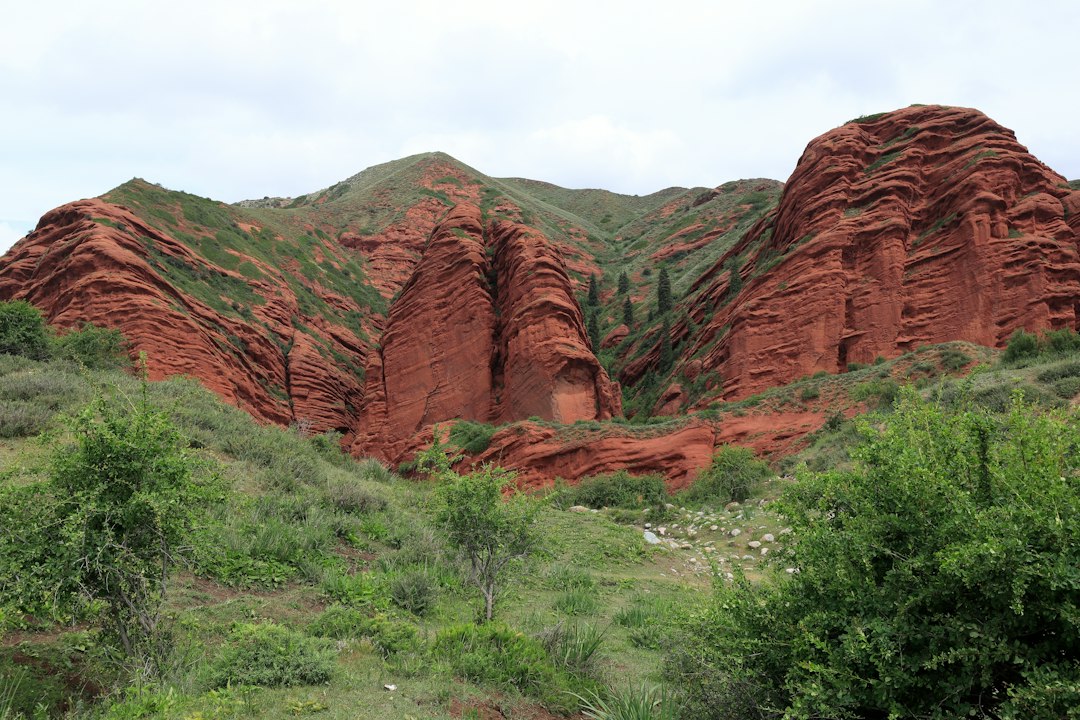
The highest formations reach several tens of meters. In certain places, small erosions in the shape of vertical channels can be seen, produced by rainwater flowing along the slopes during the summer rainy season. These grooves add an additional visual element: dark vertical lines that cut across the colored horizontal bands, creating a natural grid visible to the naked eye from any platform.
Practical Information for the Visit

The park is located about 40 kilometers from the center of Zhangye, accessible by taxi or public buses from the city train station. Zhangye is served by the Chinese high-speed rail, with connections from Lanzhou (about two hours) and Jiayuguan. The entrance ticket to the park costs around 75 yuan for the Qicai area only, with additional costs for the internal shuttle bus, which is mandatory to reach the more distant platforms.
The best time to visit is between July and September, when the summer rains make the colors more vibrant and the air is cleaner. It is advisable to avoid days with uniformly overcast skies: without direct light, the colors lose depth. It is recommended to arrive at opening time, around eight in the morning, both for the quality of light and to find the platforms less crowded. Wearing closed shoes is useful because some paths between the platforms are unpaved. The average altitude of the park exceeds 1,500 meters, so even in summer, mornings can be cool.
The geographical context
Zhangye is located along the Hexi corridor, the strip of flat territory that for centuries has been the mandatory passage of the Silk Road between central China and Central Asia. The landscape around the park is arid, dominated by steppe and desert, which makes the contrast with the colorful hills even more jarring: one exits a monochromatic environment and enters a scene that seems to belong to another geological latitude.
The Qilian Mountains, covered in snow for much of the year, are visible on the southern horizon from most platforms. That white presence in the background, combined with the colorful foreground of the Danxia hills, creates a visual layering that is hard to forget, regardless of the time of day it is observed.